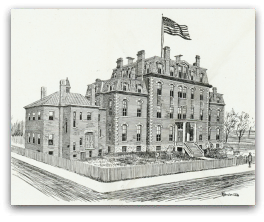
April 23. On this date in 1912, 'Abdu'l-Bahá
gave a speech
at Howard University (
recorded in
The Promulgation of Universal Peace), telling the audience "Praise be to God! You are
like the whites; there are no great distinctions left...How they fought
and sacrificed until they freed the blacks!...It was for your sake that
the whites of America made such an effort. Were it not for this effort,
universal emancipation would not have been proclaimed... In short, you
must be very thankful to the whites who were the cause of your freedom
in America....Now — praise be to God! — everyone is free and lives in
tranquillity."
But I wish to say one thing in order that the blacks may become
grateful to the whites and the whites become loving toward the blacks.
If you go to Africa and see the blacks of Africa, you will realize how
much progress you have made. Praise be to God! You are like the
whites; there are no great distinctions left. But the blacks of Africa
are treated as servants. The first proclamation of emancipation for the
blacks was made by the whites of America. How they fought and sacrificed
until they freed the blacks! Then it spread to other places.
The blacks of Africa were in complete bondage, but your emancipation led
to their freedom also — that is, the European states emulated the
Americans, and the emancipation proclamation became universal. It was
for your sake that the whites of America made such an effort. Were it
not for this effort, universal emancipation would not have been
proclaimed.
Therefore, you must be very grateful to the whites of
America, and the whites must become very loving toward you so that you
may progress in all human grades. Strive jointly to make
extraordinary progress and mix together completely. In short, you must
be very thankful to the whites who were the cause of your freedom in
America. Had you not been freed, other blacks would not have been freed
either. Now — praise be to God! — everyone is free and lives in tranquillity.
I pray that you attain to such a degree of good character and behavior
that the names of black and white shall vanish. All shall be called
human, just as the name for a flight of doves is dove. They are not
called black and white. Likewise with other birds.
Later in 1912, on September 2, 'Abdu'l-Bahá
gave a talk
elaborating his views on Africans, indigenous North Americans, native
peoples, and pre-Columbian America at the Montreal home of William
Sutherland Maxwell (later named a Hand of the Cause by Shoghi Effendi in
1951) and May Maxwell, the parents of Mary Maxwell, the future
Amatu'l-Bahá Rúhíyyih Khánum, wife of Shoghi Effendi.
Nature is the material world. When we look upon it, we see that it is
dark and imperfect. For instance, if we allow a piece of land to remain
in its natural condition, we will find it covered with thorns and
thistles; useless weeds and wild vegetation will flourish upon it, and
it will become like a jungle. The trees will be fruitless, lacking
beauty and symmetry; wild animals, noxious insects and reptiles will
abound in its dark recesses. This is the incompleteness and imperfection
of the world of nature. To change these conditions, we must clear the
ground and cultivate it so that flowers may grow instead of thorns and
weeds—that is to say, we must illumine the dark world of nature. In
their primal natural state, the forests are dim, gloomy, impenetrable.
Man opens them to the light, clears away the tangled underbrush and
plants fruitful trees. Soon the wild woodlands and jungle are changed
into productive orchards and beautiful gardens; order has replaced
chaos; the dark realm of nature has become illumined and brightened by
cultivation.
If man himself is left in his natural state, he will become lower
than the animal and continue to grow more ignorant and imperfect. The
savage tribes of central Africa are evidences of this. Left in their
natural condition, they have sunk to the lowest depths and degrees of
barbarism, dimly groping in a world of mental and moral obscurity. If we
wish to illumine this dark plane of human existence, we must bring man
forth from the hopeless captivity of nature, educate him and show him
the pathway of light and knowledge, until, uplifted from his condition
of ignorance, he becomes wise and knowing; no longer savage and
revengeful, he becomes civilized and kind; once evil and sinister, he is
endowed with the attributes of heaven. But left in his natural
condition without education and training, it is certain that he will
become more depraved and vicious than the animal, even to the extreme
degree witnessed among African tribes who practice cannibalism. It is
evident, therefore, that the world of nature is incomplete, imperfect
until awakened and illumined by the light and stimulus of education.
In these days there are new schools of philosophy blindly claiming
that the world of nature is perfect. If this is true, why are children
trained and educated in schools, and what is the need of extended
courses in sciences, arts and letters in colleges and universities? What
would be the result if humanity were left in its natural condition
without education or training? All scientific discoveries and
attainments are the outcomes of knowledge and education. The telegraph,
phonograph, telephone were latent and potential in the world of nature
but would never have come forth into the realm of visibility unless man
through education had penetrated and discovered the laws which control
them. All the marvelous developments and miracles of what we call
civilization would have remained hidden, unknown and, so to speak,
nonexistent, if man had remained in his natural condition, deprived of
the bounties, blessings and benefits of education and mental culture.
The intrinsic difference between the ignorant man and the astute
philosopher is that the former has not been lifted out of his natural
condition, while the latter has undergone systematic training and
education in schools and colleges until his mind has awakened and
unfolded to higher realms of thought and perception; otherwise, both are
human and natural.
God has sent forth the Prophets for the purpose of quickening the
soul of man into higher and divine recognitions. He has revealed the
heavenly Books for this great purpose. For this the breaths of the Holy
Spirit have been wafted through the gardens of human hearts, the doors
of the divine Kingdom opened to mankind and the invisible inspirations
sent forth from on high. This divine and ideal power has been bestowed
upon man in order that he may purify himself from the imperfections of
nature and uplift his soul to the realm of might and power. God has
purposed that the darkness of the world of nature shall be dispelled and
the imperfect attributes of the natal self be effaced in the effulgent
reflection of the Sun of Truth. The mission of the Prophets of God has
been to train the souls of humanity and free them from the thralldom of
natural instincts and physical tendencies. They are like unto Gardeners,
and the world of humanity is the field of Their cultivation, the
wilderness and untrained jungle growth wherein They proceed to labor.
They cause the crooked branches to become straightened, the fruitless
trees to become fruitful, and gradually transform this great wild,
uncultivated field into a beautiful orchard producing wonderful
abundance and outcome.
If the world of nature were perfect and complete in itself, there
would be no need of such training and cultivation in the human world—no
need of teachers, schools and universities, arts and crafts. The
revelations of the Prophets of God would not have been necessary, and
the heavenly Books would have been superfluous. If the world of nature
were perfect and sufficient for mankind, we would have no need of God
and our belief in Him. Therefore, the bestowal of all these great helps
and accessories to the attainment of divine life is because the world of
nature is incomplete and imperfect. Consider this Canadian
country during the early history of Montreal when the land was in its
wild, uncultivated and natural condition. The soil was unproductive,
rocky and almost uninhabitable—vast forests stretching in every
direction. What invisible power caused this great metropolis to spring
up amid such savage and forbidding conditions? It was the human mind.
Therefore, nature and the effect of nature’s laws were imperfect. The
mind of man remedied and removed this imperfect condition, until now we
behold a great city instead of a savage unbroken wilderness. Before the
coming of Columbus America itself was a wild, uncultivated expanse of
primeval forest, mountains and rivers—a very world of nature. Now it has
become the world of man. It was dark, forbidding and savage; now it has
become illumined with a great civilization and prosperity. Instead of
forests, we behold productive farms, beautiful gardens and prolific
orchards. Instead of thorns and useless vegetation, we find flowers,
domestic animals and fields awaiting harvest. If the world of nature
were perfect, the condition of this great country would have been left
unchanged.
If a child is left in its natural state and deprived of
education, there is no doubt that it will grow up in ignorance and
illiteracy, its mental faculties dulled and dimmed; in fact, it will
become like an animal. This is evident among the savages of central
Africa, who are scarcely higher than the beast in mental development.
The conclusion is irresistible that the splendors of the Sun of
Truth, the Word of God, have been the source and cause of human
upbuilding and civilization. The world of nature is the kingdom of the
animal. In its natural condition and plane of limitation the animal is
perfect. The ferocious beasts of prey have been completely subject to
the laws of nature in their development. They are without education or
training; they have no power of abstract reasoning and intellectual
ideals; they have no touch with the spiritual world and are without
conception of God or the Holy Spirit. The animal can neither recognize
nor apprehend the spiritual power of man and makes no distinction
between man and itself, for the reason that its susceptibilities are
limited to the plane of the senses. It lives under the bondage of nature
and nature’s laws. All the animals are materialists. They are deniers
of God and without realization of a transcendent power in the universe.
They have no knowledge of the divine Prophets and Holy Books—mere
captives of nature and the sense world. In reality they are like the
great philosophers of this day who are not in touch with God and the
Holy Spirit—deniers of the Prophets, ignorant of spiritual
susceptibilities, deprived of the heavenly bounties and without belief
in the supernatural power. The animal lives this kind of life blissfully
and untroubled, whereas the material philosophers labor and study for
ten or twenty years in schools and colleges, denying God, the Holy
Spirit and divine inspirations. The animal is even a greater
philosopher, for it attains the ability to do this without labor and
study. For instance, the cow denies God and the Holy Spirit, knows
nothing of divine inspirations, heavenly bounties or spiritual emotions
and is a stranger to the world of hearts. Like the philosophers, the cow
is a captive of nature and knows nothing beyond the range of the
senses. The philosophers, however, glory in this, saying, “We are not
captives of superstitions; we have implicit faith in the impressions of
the senses and know nothing beyond the realm of nature, which contains
and covers everything.” But the cow, without study or proficiency in the
sciences, modestly and quietly views life from the same standpoint,
living in harmony with nature’s laws in the utmost dignity and nobility.
This is not the glory of man. The glory of man is in the knowledge of
God, spiritual susceptibilities, attainment to transcendent powers and
the bounties of the Holy Spirit. The glory of man is in being informed
of the teachings of God. This is the glory of humanity. Ignorance is not
glory but darkness. Can these souls who are steeped in the lower strata
of ignorance become informed of the mysteries of God and the realities
of existence while Jesus Christ was without knowledge of them? Is the
intellect of these people greater than the intellect of Christ? Christ
was heavenly, divine and belonged to the world of the Kingdom. He was
the embodiment of spiritual knowledge. His intellect was superior to
these philosophers, His comprehension deeper, His perception keener, His
knowledge more perfect. How is it that He overlooked and denied Himself
everything in this world? He attached little importance to this
material life, denying Himself rest and composure, accepting trials and
voluntarily suffering vicissitudes because He was endowed with spiritual
susceptibilities and the power of the Holy Spirit. He beheld the
splendors of the divine Kingdom, embodied the bounties of God and
possessed ideal powers. He was illumined with love and mercy, and so,
likewise, were all the Prophets of God.

No comments:
Post a Comment